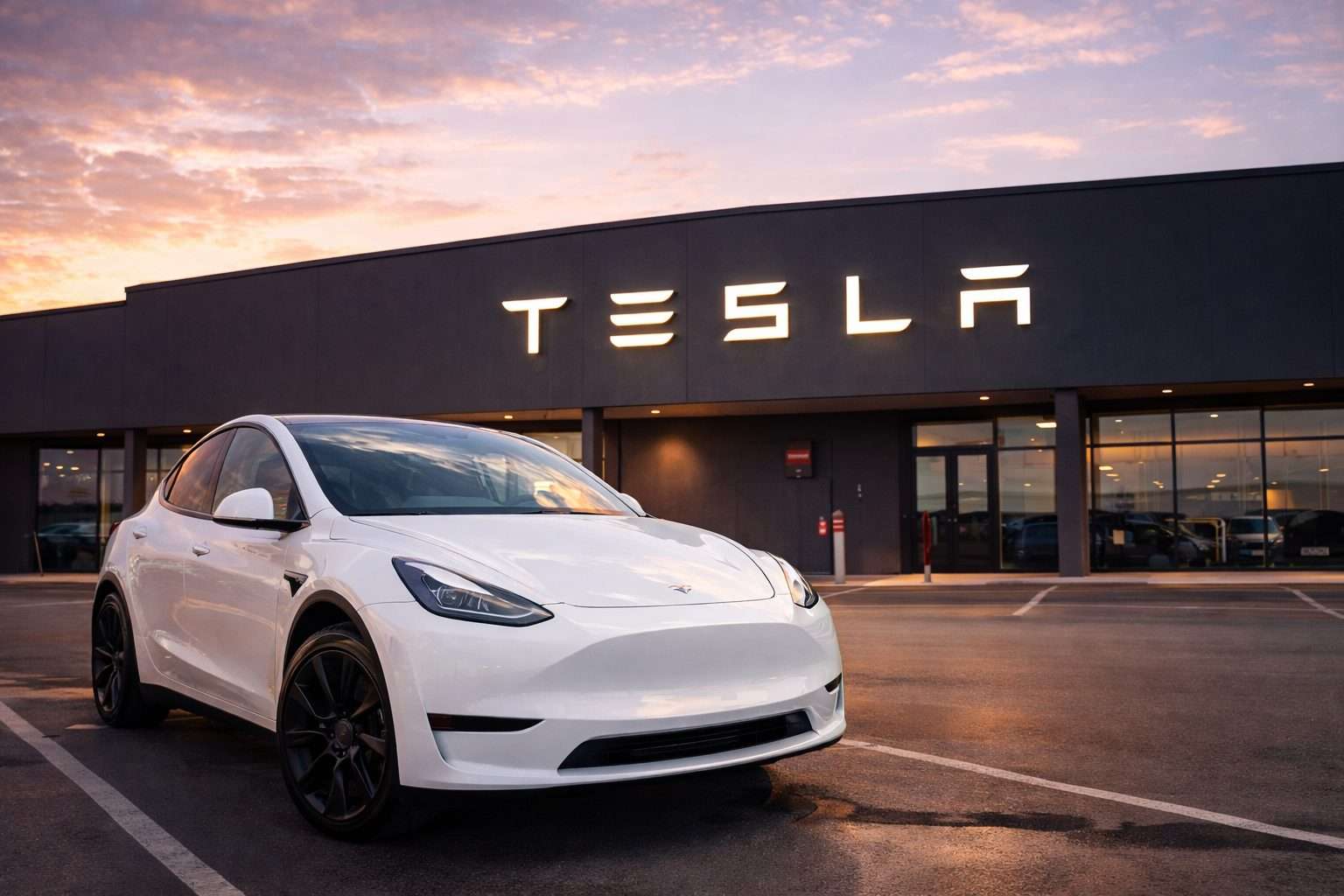

New York, Feb 23, 2026, 07:01 EST — Premarket
- Tesla shares hovered near flat in premarket trading following Friday’s close.
- U.S. futures edged lower after President Donald Trump unveiled a fresh 15% tariff on global goods.
- Investors now face questions around the coming era of automated driving—and the liability issues that tag along.
Tesla shares ticked up $0.14 to $411.82 ahead of Monday’s open, following a previous close of $411.68.
The stock tracked lower alongside a sluggish tape. U.S. index futures edged down following President Donald Trump’s announcement of a 15% global tariff, which brought fresh uncertainty for supply chains and raised concerns over costs for globally operating firms.
A Reuters report drew attention to a widening rift in the car industry over “eyes-off” driving tech—Level 3 systems that let motorists avert their gaze in specific scenarios but demand a quick handoff back to the human. Former Waymo chief John Krafcik wasn’t convinced, calling it a case where “the juice isn’t worth the squeeze.” Paul Thomas, who runs Bosch North America, echoed that uncertainty, telling Reuters: “We don’t know if Level 3 ever makes financial sense.” For now, most vehicles—including Tesla’s Full Self-Driving—stick to Level 2, which keeps drivers’ eyes glued to the road. Tesla’s limited robotaxi program is up and running, with ambitions for broader U.S. rollout in the first half of 2026, landing it squarely in competition with Waymo, Alphabet’s autonomous driving unit. Reuters
Tesla’s stock reacts sharply to shifts in risk appetite, thanks to its status as a high-beta growth play rather than a straightforward automaker. Macro headlines often get reflected quickly in stocks like this, where future potential is already baked into the price.
What’s ahead remains uncertain. Tesla’s been touting autonomy for years, but the reality for the industry has been much trickier: partial hands-off, eyes-off systems, limited to specific scenarios, are costly, tough to ramp up, and confusing for customers.
The trouble spot is handoff. Wait too long to nudge the driver—there’s your crash headline. Nudge too frequently, though, and people just quit using the system. Both scenarios? Legal bills, and they’re the carmaker’s to pay.
Competition’s getting complicated. Traditional automakers have dipped into Level 3 in select rollouts, but Chinese brands are weaving advanced driver-assist tech straight into the price tag—putting more pressure on the subscription-based revenue streams.
Still, Tesla’s immediate setup probably hangs on tariff chatter and how tech is trading. If new trade tensions spook buyers or make supply chains murkier, the company doesn’t have much of a buffer.
Bulls face a real risk: autonomy may not guarantee lasting margins. Development expenses run steep, regulators aren’t quick to act, and a major safety incident could push the timeline back again.
All eyes on the cash session open later Monday. Investors are tracking tariff uncertainty and its impact on growth stocks, while Tesla’s ability to maintain recent levels—despite a lack of new headlines—remains a key question.