
Bellevue, Washington—April 18, 2026, 09:32 PDT.
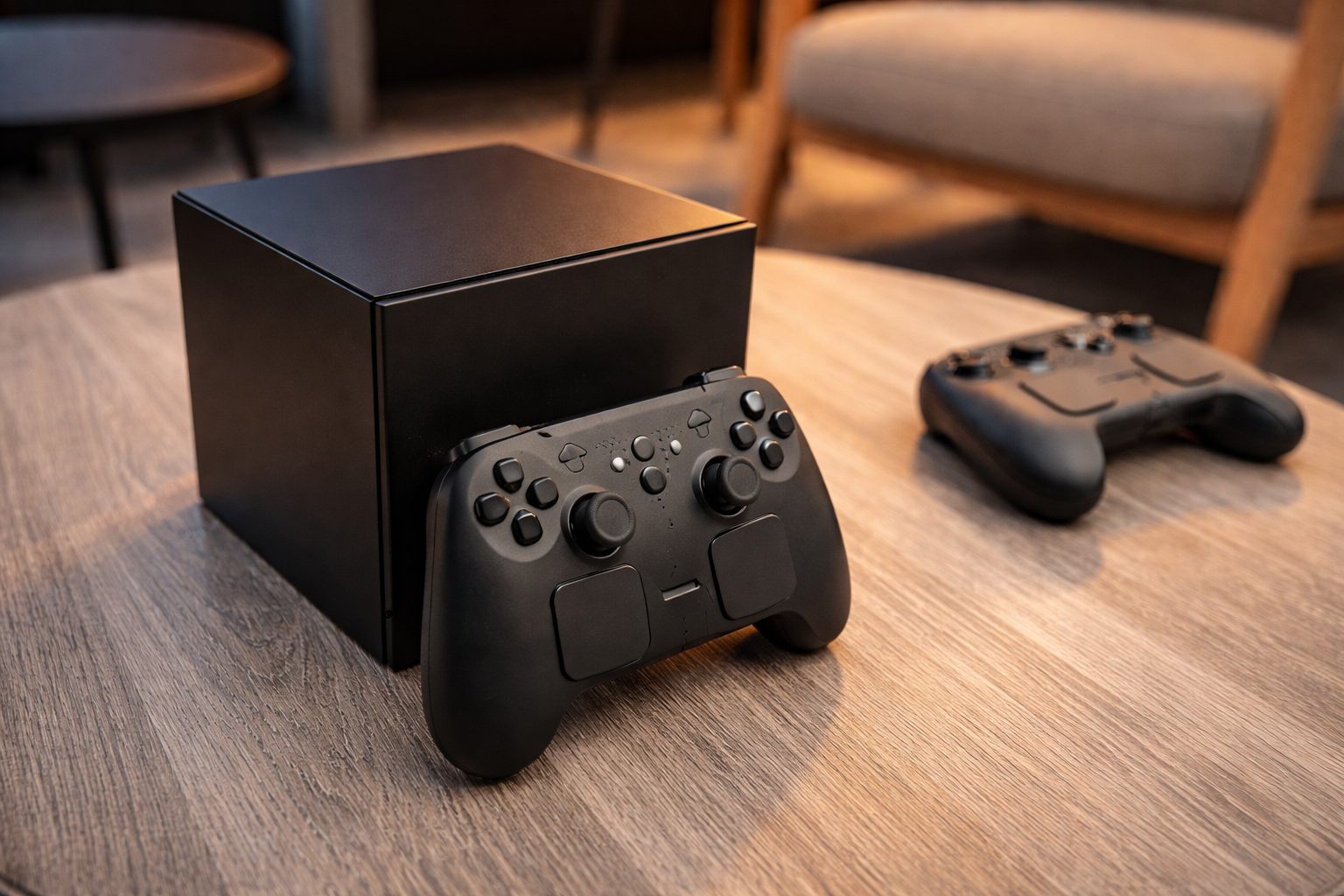
Valve’s Steam Machine remains officially unpriced, but the spotlight is back on cost after controller shipments reportedly arrived stateside. At the same time, a $950 do-it-yourself build has popped up, offering potential buyers a fresh point of comparison.
Valve’s got a challenge on its hands: as it tries to expand SteamOS—the Linux gaming system behind the Steam Deck—into living rooms, memory and storage costs are squeezing hardware budgets. The company had hoped to reveal pricing and launch dates already, but scrapped those announcements earlier this year after key components became hard to find and prices shot up.
Valve insists it’s sticking with the 2026 rollout for its Steam Machine, Steam Frame VR headset, and latest Steam Controller—even after a tweak to its blog wording sparked talk of fresh holdups. “Nothing has actually changed on our end,” Valve PR rep Kaci Aitchison Boyle told The Verge. The Verge
Rumors are swirling in some specialist circles. TechRadar, citing import records flagged by Brad Lynch and picked up by VideoCardz, reports that Valve has brought in a shipment marked as “wireless PC controller.” It’s a sizable delivery: 40 packages with a combined weight of 12,970 kg. That said, the paperwork doesn’t reveal how many units are actually in the batch. TechRadar
According to publicly available import data spotted by PCGamesN, the shipment was headed to Valve. The publication did flag that the manifest alone can’t pin down a launch date. Still, PCGamesN points to the import activity as a sign Valve might be amassing controllers, even as the Steam Machine keeps hitting roadblocks from component costs.
The pricing chatter kicked off after YouTuber Zac Builds threw together a Steam Machine-like setup for about $950. His build: Ryzen 5 5600X CPU, Radeon RX 9060 XT with 16 GB VRAM, 16 GB of DDR4 RAM, and a 2 TB SSD. SteamOS was out—the new GPU just wouldn’t cooperate—so he installed Bazzite, a Linux distro closely modeled on SteamOS.
Games.gg says the setup ran Cyberpunk 2077 and Spider-Man 2 in 4K, reaching 60 fps with FSR upscaling—AMD’s take on sharper visuals. That $950 sticker? The site notes it reflects a stack of single-use discounts, so lining it up against typical retail pricing isn’t straightforward.
That caveat isn’t trivial. Valve’s device arrives as a cohesive product—SteamOS pre-installed, official support, plug-in simplicity. It’s tailored for the living room, controller-first. On the DIY side: yes, faster hardware might be possible, but buyers face the hunt for parts, assembly headaches, software hassles, and no guaranteed reliability.
Price targets are all over the map. Circana’s Mat Piscatella told GamesRadar+ he could see anything—$700, $800, even $1,000 tags. More immediate, though, he pointed to Valve’s supply chain as the bigger unknown: where the parts get sourced, total units, and how distribution shapes up. “I’m glad I’m not responsible for picking,” Piscatella said. GamesRadar+
Valve isn’t taking the route of Sony and Microsoft when it comes to the Steam Machine—they’re not planning to sell it below cost. Engineer Pierre-Loup Griffais told reporters the price should land where you’d expect for a PC with similar specs. He highlighted the compact form factor, quiet operation, and living-room-ready design as justifying the price.
Valve isn’t alone in feeling the squeeze. Meta plans to raise prices for its Quest 3 and Quest 3S headsets on April 19, citing more expensive memory chips—a fresh reminder that supply headaches still hang over the VR and gaming hardware space. The 512 GB Quest 3 will jump to $600 in the U.S., PC Gamer reports.
Valve hasn’t let up on software updates. SteamOS 3.8.0 landed with “initial support for upcoming Steam Machine hardware,” along with updates in desktop mode, lower latency for controllers, and improved compatibility when hooking up to external HDR and variable refresh rate screens. Those upgrades—staples for TV and monitor setups—are especially relevant if you’re using a PC in the living room, less crucial for handheld play. Tom’s Hardware
Valve has pushed out a Proton 11 beta with Arm64 support, PC Gamer reports. Proton serves as the company’s compatibility layer, letting Windows titles run on Linux-powered SteamOS. Arm64 efforts seem aimed at Steam Frame, but the mission hasn’t changed: expand the Steam library on Valve hardware, sparing developers from extra porting.
The risk is hard to miss. If Valve puts the Steam Machine price tag near that rumored $950-to-$1,000 range, plenty of buyers could balk—particularly folks eyeing consoles or considering building their own PC setups. Drop the price much further, and Valve eats the difference, with memory and storage expenses still jumping around.
Valve clearly isn’t struggling to attract fans—the idea alone generates plenty of buzz. But the price? Still a blank. No details on cost or launch date yet, so in the meantime, controller rumors, Reddit speculation, and DIY prototypes have stepped in to fill that hole for now.