
Warsaw, 2 Feb 2026, 17:00 CET
- Recent studies reveal the first direct methane detection in an interstellar object and uncover a nucleus larger than expected for comet 3I/ATLAS
- These findings stem from December observations made by the James Webb and Hubble space telescopes, now detailed in preprints
- As the comet dims on its way out of the inner solar system, scientists are scrambling to analyze the data.
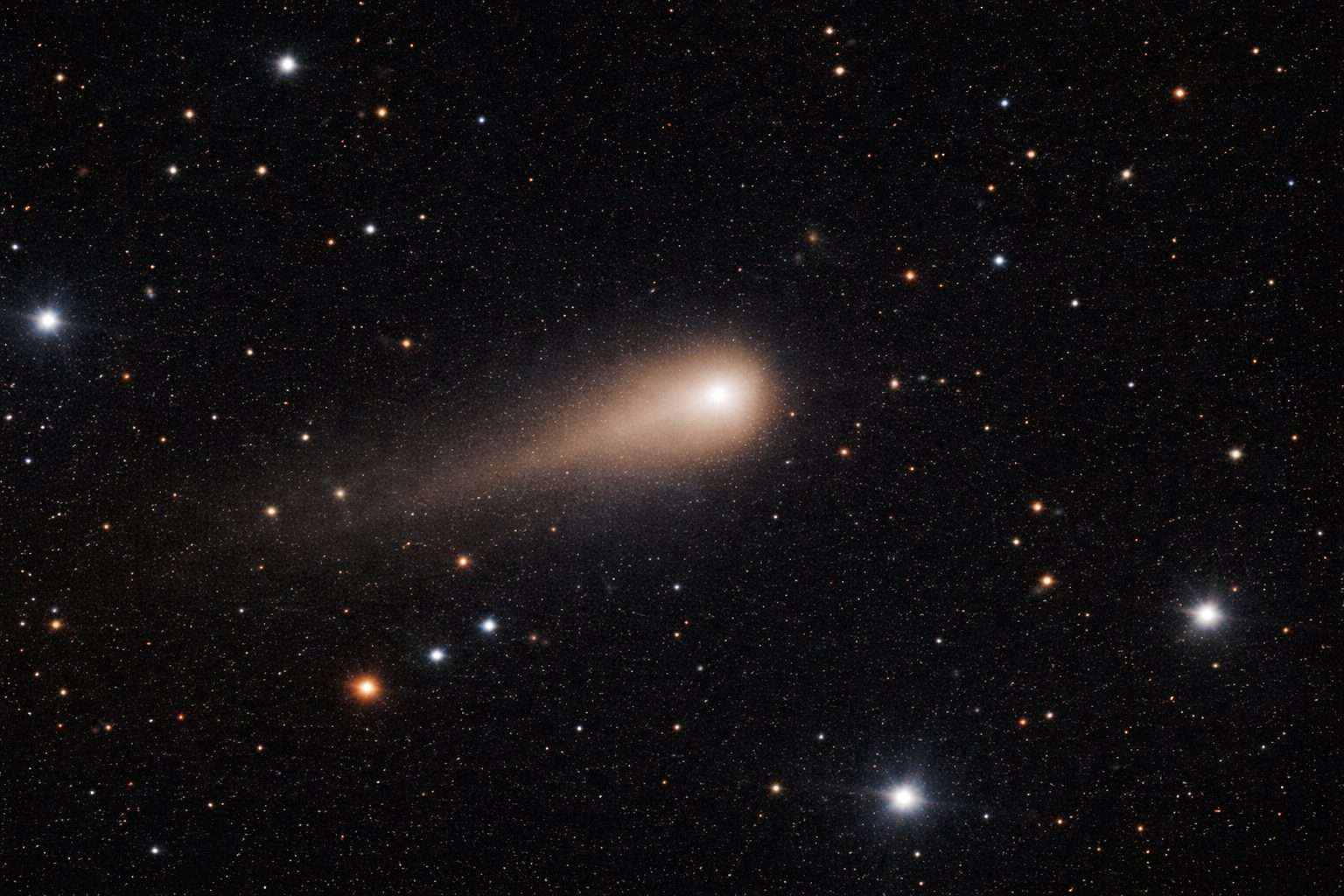
Two research groups analyzing the interstellar comet 3I/ATLAS report directly detecting methane in its gas cloud and estimate its nucleus measures roughly 2.6 km (1.6 miles) wide — a rare feat for an object formed around a different star, according to papers posted on arXiv.
The urgency is clear: just three confirmed interstellar visitors have been spotted in our solar system, and each presents a brief, quickly fading opportunity to study how planets and comets form beyond our own neighborhood.
3I/ATLAS is now on its way out, and the updated chemistry and size limits give researchers key data to contrast this visitor with typical comets formed under our sun’s influence.
Researchers behind the James Webb study used the telescope’s Mid-Infrared Instrument, or MIRI, to capture spectra—basically chemical fingerprints—right after the comet passed perihelion, its closest approach to the sun. They detected methane and found signs linked to water, carbon dioxide, and even a nickel line.
The Webb team noted that methane production trailed water, suggesting methane near the surface had been used up earlier. This left the telescope to detect methane rising from deeper layers later on. They also observed that outgassing — gas released as ices warmed — dropped over roughly two weeks.
Using a “nucleus extraction” method, the separate Hubble study isolated the solid core’s signal from the brighter coma. The team calculated an effective radius near 1.3 km, based on a comet-like albedo—reflectivity—of 0.04. arXiv
The same paper noted the comet’s brightness shifts might match a stretched nucleus, with an axis ratio of at least 2-to-1 and a rotation period exceeding an hour, but it warned these conclusions hinge on the cause behind the variation.
Avi Loeb, a Harvard scientist who has often written about 3I/ATLAS, described the nucleus estimate as the crucial figure, stating that “the nucleus is inferred to have an effective diameter of 2.6 (±0.4) kilometers.” Medium
The ATLAS survey’s telescope in Chile first spotted the comet back in July 2025, sparking worldwide interest as NASA and other agencies tracked it using various instruments. NASA officials quickly shut down rumors it might be anything but a comet. Nicola Fox described it as “our friendly solar system visitor,” while Chris Lintott dismissed claims calling 3I/ATLAS an alien spacecraft as “simply nonsense.” Reuters
There could be more data on the way. The European Space Agency confirmed that its Jupiter mission, Juice, did observe the comet. However, the science data is expected to land only in February. That’s because the spacecraft is using its main antenna as a heat shield, which forces it to transmit information more slowly.
There’s a catch with the new claims: both studies are preprints, shared before undergoing peer review. Plus, several crucial figures rely heavily on models. For instance, the Hubble size estimate depends on an assumed albedo, while understanding methane production requires how researchers model heating, dust, and gas flow in an active coma.
Still, the Hubble team noted their data suggests many objects like 3I/ATLAS likely went unnoticed in earlier surveys before astronomers spotted 2017’s ‘Oumuamua and 2019’s Borisov — a sign these visitors might be more common than previously thought, just tougher to detect.