
Paris, March 5, 2026, 08:33 CET
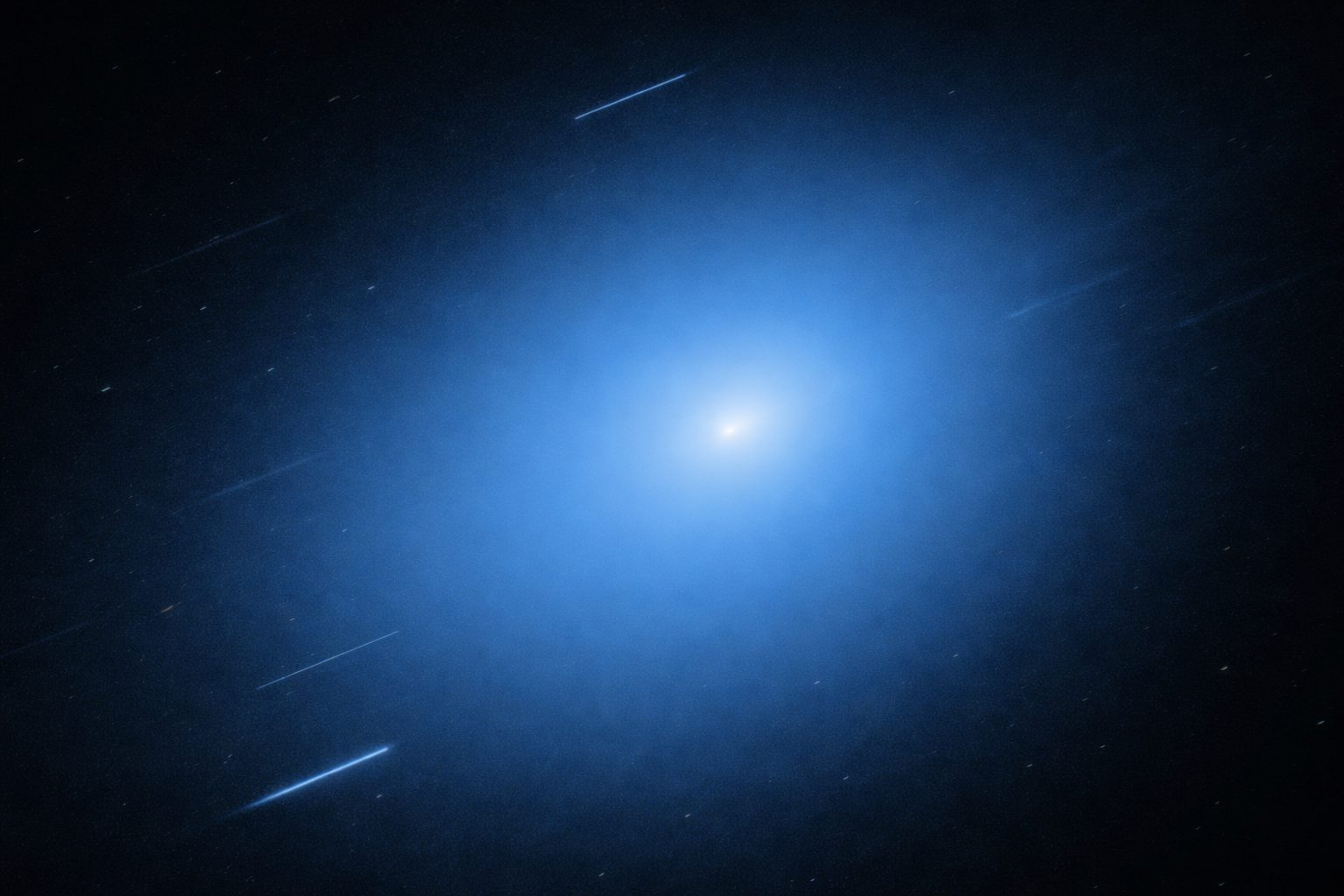
- The European Space Agency has put out a fresh image of interstellar comet 3I/ATLAS, snapped by its JUICE spacecraft as it heads toward Jupiter.
- During its observing run in November 2025, JUICE’s JANUS camera snapped over 120 images of the comet.
- Scientists are sifting through data from several instruments, delayed in its downlink, and a joint review is set for late March.
The European Space Agency has published a fresh shot of interstellar comet 3I/ATLAS, picked up by its Jupiter Icy Moons Explorer (Juice), which is heading for Jupiter. The image, snapped by Juice’s JANUS science camera on Nov. 6, 2025, from a distance of roughly 66 million km (41 million miles), shows a luminous gas halo trailing a distinctive tail. According to ESA, JANUS logged over 120 images during the session.
3I/ATLAS has become just the third confirmed interstellar visitor to sweep through our solar system, following 1I/‘Oumuamua’s 2017 flyby and 2I/Borisov in 2019. The ATLAS survey telescope in Río Hurtado, Chile, picked it up on July 1, 2025. According to ESA, the comet barreled past the Sun at speeds topping 250,000 km/h. Earth was never in its path — its closest point was about 270 million km away — yet researchers are eager to study it for its cargo: material that once circled another star.
Juice squeezed in its comet observations alongside its main mission to explore Jupiter’s icy moons. ESA said that after collecting the data, the probe shifted behind the Sun relative to Earth and had to rely on its smaller antenna to transmit, since the main high-gain dish was used as a heat shield—slowing the flow of information back. Most of the 3I/ATLAS data set landed in late February. Now, instrument teams are set to gather in late March to cross-check results from the cameras, spectrometers, and particle sensors.
The JANUS image doesn’t show the comet’s nucleus, but the coma—created when sunlight heats up the surface and releases gas and dust—shows up as a bright, egg-like haze. Behind it, the tail spreads, with wispy lines that researchers plan to examine for outgassing-driven jets and filaments.
JANUS operated with the rest of the Juice payload for this observing run. MAJIS and UVS both handle spectrometry, breaking light apart for chemical clues, while SWI looks at composition in the sub-millimetre range. PEP, on the other hand, tracks charged particle activity.
ESA is weaving the latest Juice images into a wider campaign that’s pulled data from both ground-based telescopes and observatories in orbit. According to the agency, Hubble and the James Webb Space Telescope have also tracked the comet during its pass through the inner solar system.
Pulling reliable data on 3I/ATLAS has been tricky—the comet’s both dim and moving quickly. “The comet is around 10,000 to 100,000 times fainter than our usual target,” said Nick Thomas, the principal investigator for ExoMars’ CaSSIS camera, in an earlier ESA update covering comet observations. European Space Agency
Juice, which began its journey in 2023, is en route to Jupiter to investigate moons including Ganymede, Callisto, and Europa. Scientists are intrigued by these bodies—some may conceal oceans under their frozen surfaces, which could have implications for the search for life.
The fresh comet image offers just an early glimpse—just a sliver of a broader trove of data. Quick-look processing can easily trip things up. Teams still face calibration, sorting out viewing angles, and figuring out which features actually exist and which are just noise or artefacts.
ESA says additional results are coming after instrument teams wrap up their initial review and exchange data in late March. The interstellar visitor, meanwhile, is already heading out, and now researchers on Earth face the painstaking analysis.