
WASHINGTON, February 4, 2026, 12:16 EST
- Juno’s latest data measures Jupiter’s equatorial diameter at 88,841 miles (142,976 km), roughly 5 miles (8 km) less than previous estimates
- Jupiter’s diameter from pole to pole measures 83,067 miles (133,684 km), roughly 15 miles (24 km) less, which makes the planet appear even more “flattened”
- During Juno flybys, scientists employed radio occultation—a method that measures how the planet bends and delays radio signals from the spacecraft
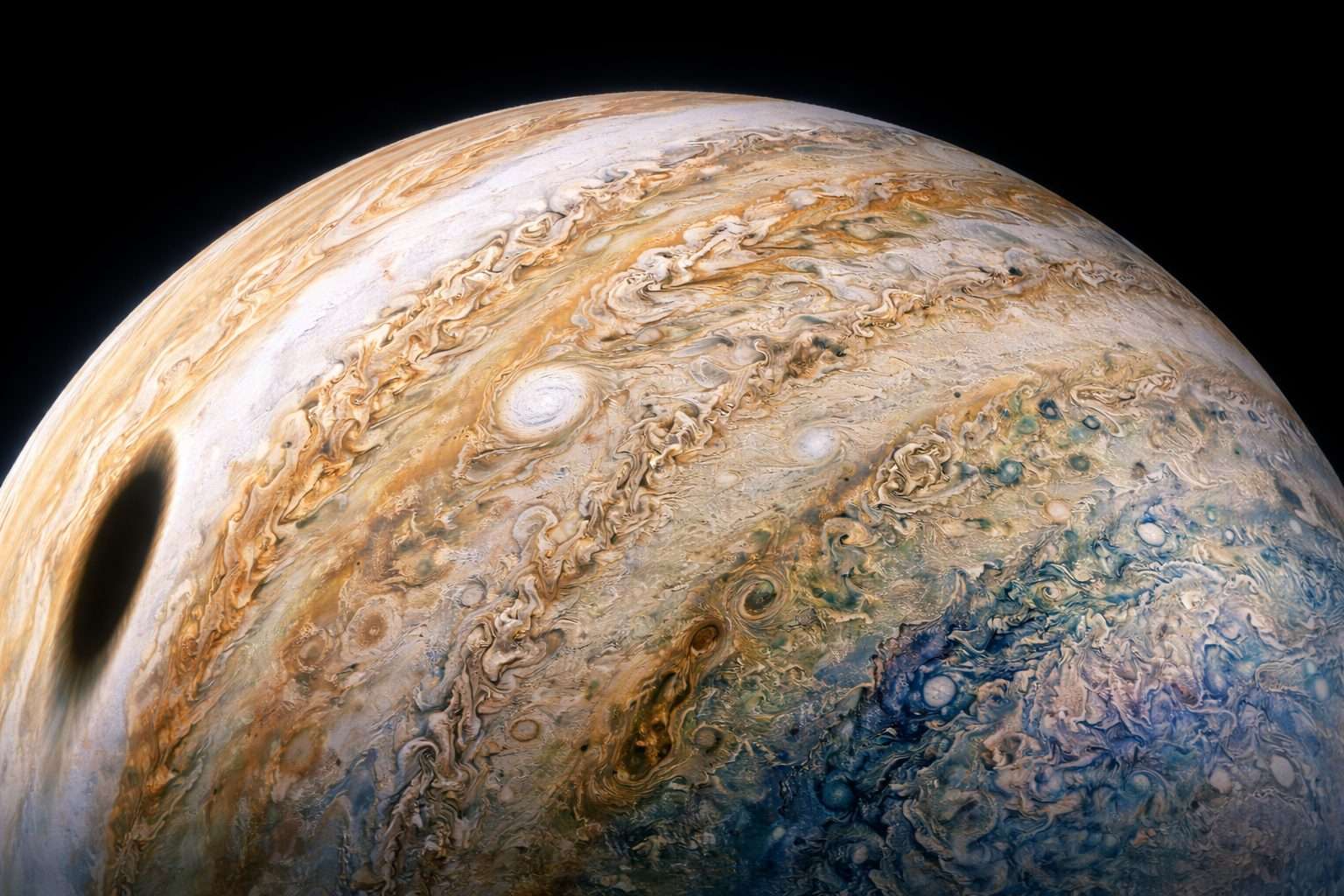
NASA’s Juno spacecraft has produced the most accurate measurements to date of Jupiter’s size and shape, revealing that the giant planet is a bit smaller than previously believed. These revised numbers appear in a study published this week in Nature Astronomy.
The change in Jupiter’s radius is slight, but it’s significant since this measurement serves as a key reference for modeling the planet’s interior and atmosphere. These models, in turn, shape scientists’ broader understanding of gas giants, including those orbiting distant stars.
The latest analysis uses radio occultation, a technique that “reads” a planet’s edge by tracking how a spacecraft’s radio signal bends and slows as it passes through the upper atmosphere en route to Earth. NASA explained the team analyzed data from 13 Juno flybys and factored in zonal winds — those rapid east-west jets that can subtly alter Jupiter’s measured outline. NASA
Juno found Jupiter’s equatorial diameter to be 88,841 miles (142,976 km), roughly 5 miles (8 km) less than past measurements. From pole to pole, the gas giant measures 83,067 miles (133,684 km), about 15 miles (24 km) shorter than previously thought.
The planet isn’t a perfect sphere, and the latest data reveal just how much it’s flattened. Jupiter’s diameter at the equator is roughly 7% greater than at its poles, a stark difference compared to Earth’s modest 0.33%, researchers reported.
Part of the timing came down to orbital luck. Eli Galanti, lead author from Israel’s Weizmann Institute of Science, explained that Juno only achieved the right geometry after its mission was extended. That’s when the spacecraft’s signal passed through Jupiter’s atmosphere during a behind-the-planet alignment. “Measuring how the signal changed” during this window was key to determining the planet’s size and shape, he said.
Yohai Kaspi from the Weizmann Institute noted, “Textbooks will need to be updated,” emphasizing that the planet itself hasn’t shrunk — just our measurements improved. The previous baseline came from a handful of radio occultation experiments during NASA’s Pioneer and Voyager flybys back in the 1970s. Space
Maria Smirnova, also from Weizmann, explained that the team analyzed how Juno’s radio signals refract through Jupiter’s atmosphere, using that data to create temperature and density maps. This method yielded the “clearest picture yet” of the planet’s outline.
Even on a planet this massive, tiny differences make an impact. Galanti explained, “These few kilometers matter,” since adjusting the radius just a bit can align interior models more closely with gravity and atmospheric measurements.
The impact goes beyond just Jupiter. NASA explained that Jupiter’s radius serves as a key calibration benchmark for astronomers studying giant exoplanets—particularly those spotted during transits in front of their stars—since minor tweaks in size assumptions can throw off calculations of density and internal makeup.
Pinning down the exact “size” of a gas giant is tricky. Jupiter lacks a solid surface, so the measurement relies on where its upper atmosphere and winds set the boundary scientists call the planet’s edge. Plus, radio signals passing through its ionosphere add another layer of complexity.
Juno, which blasted off in 2011 and has been circling Jupiter since 2016, is busy charting the planet’s atmosphere, interior, magnetic field, and magnetosphere. Jupiter, made up mostly of hydrogen and helium, is immense—big enough to swallow all the other planets combined, packing in over 1,300 Earths, according to researchers.