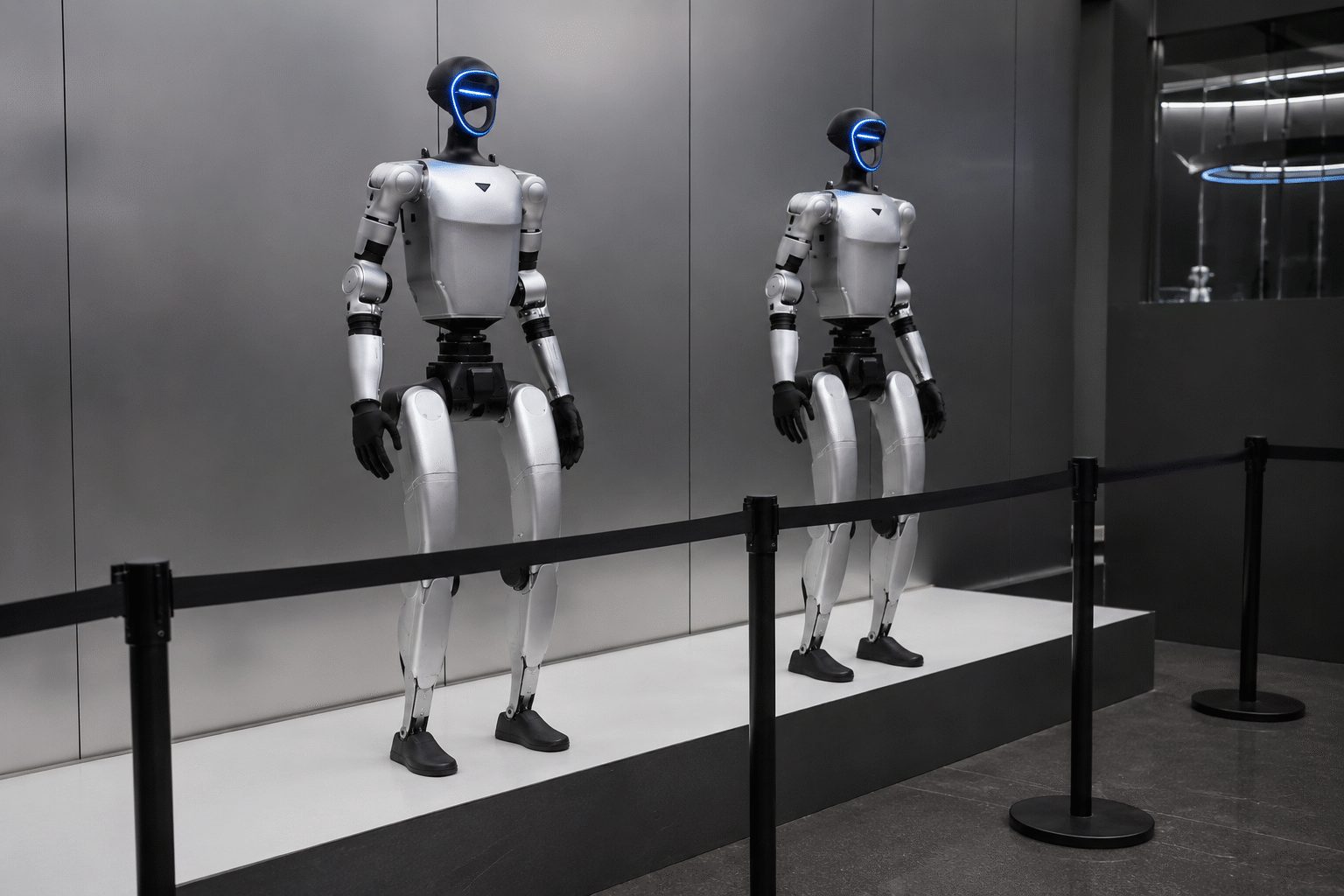

BEIJING, August 21, 2026, 23:11 CST
- Unitree closed Friday at 672.41 yuan, holding a 346% gain over its IPO price.
- Chief Executive Wang Xingxing said robot software is still the main roadblock.
- Unitree sells its humanoid robots for $4,900 to $29,900 before tax and shipping.
Unitree (SHA:688836) has built up a market cap near $40 billion, but its CEO says humanoid software is still far off from where it needs to be. That shortfall is now at the center of the industry’s main public trial.
Shares finished Friday at 672.41 yuan, down 20.4% from Wednesday’s first close at 845 yuan, but still up 345.9% on the IPO price of 150.80 yuan. The stock started trading at 1,100 yuan on debut, which briefly put Unitree’s value near $67 billion.
| Trading milestone | Price | Change from IPO |
|---|---|---|
| IPO price on August 19 | 150.80 yuan | — |
| Opened at debut | 1,100.00 yuan | +629.4% |
| Closed first session | 845.00 yuan | +460.3% |
| Finished August 20 | 687.00 yuan | +355.6% |
| Closed August 21 | 672.41 yuan | +345.9% |
“We are marching towards a ‘ChatGPT moment’ in embodied intelligence,” founder and CEO Wang Xingxing told the World Robot Conference. He said the line will be crossed when a robot can do most tasks in a new home just from simple instructions. Reuters
Wang kept to a cautious timeline, saying a big move in software might show up in two or three years if things go well. In a less optimistic case, he put the wait at five to 10 years.
This is a bigger issue than another hardware upgrade. Unitree has stronger robots now, but CEO Wang said the real bottleneck is still in the decision-making models, which keeps mass adoption out of reach. The company’s prospectus shows most buyers are still universities and research labs.
| Unitree humanoid | Starting price | Height | Weight | Degrees of freedom | Battery life |
|---|---|---|---|---|---|
| R1 Air | $4,900 | 1.23 m | Roughly 27 kg | 20 | Roughly 1 hour |
| G1 | $13,500 | 1.32 m | Roughly 35 kg | 23 | Roughly 2 hours |
| H2 | $29,900 | 1.82 m | Roughly 70 kg | 31 | Roughly 3 hours |
The lineup points to how just looking at specs can fool buyers. The H2 has more joints, lasts three hours on a charge, and puts out more torque. Still, those numbers don’t guarantee it can work on its own in a new setting.
Unitree turned in strong commercial numbers. Revenue hit around 1.70 billion yuan in 2025, up from 392.77 million yuan the year before. Net profit came in at 278.21 million yuan. Sales of humanoids brought in 868 million yuan, making up 51.78% of total revenue.
Change came quickly. Humanoids made up just 1.88% of revenue in 2023. Quadrupeds brought in 75.78%. In 2025, humanoids led revenue, taking the top spot.
| Operating measure | Earlier period | Latest verified period |
|---|---|---|
| Total revenue | 392.77 million yuan, 2024 | About 1.70 billion yuan, 2025 |
| Humanoid revenue share | 1.88%, 2023 | 51.78%, 2025 |
| Humanoid revenue | Not disclosed in cited summary | 868 million yuan, 2025 |
| Net profit | Not disclosed in cited summary | 278.21 million yuan, 2025 |
| First-half revenue outlook | — | 1.052–1.128 billion yuan, 2026 |
Unitree brought in about 6.1 billion yuan in its IPO, selling about 10% of the company after the deal. The company said it plans to put the money toward model research, robot body development, product launches and boosting manufacturing.
| Announced IPO project | Planned allocation | Share of listed project allocations |
|---|---|---|
| R&D for intelligent robot models | 2.022 billion yuan | 48.1% |
| Development of robot bodies | 1.110 billion yuan | 26.4% |
| Factory base | 624 million yuan | 14.9% |
| R&D on new robot products | 445 million yuan | 10.6% |
About half of those project funds are going to models. That fits with Wang’s take—the real bottleneck isn’t more actuators, but software that works in different homes, factories and warehouses.
China sent over 40,000 humanoid robots in the first six months of 2026, an industry group told Reuters. That was 97% of all global deliveries. The group also said most of these machines are still less efficient than people at most tasks.
Risks: The valuation counts on quick commercial uptake. But growth could slow if rollouts hit delays, if autonomy falls short, if prices drop, or if future U.S. import limits take effect. The company also notes that some showcased features are still in development.
Unitree needs to move from one-off profitable research sales to repeat deployments. The stock ended lower Friday, a sign that investors are changing their view on how long that will take.