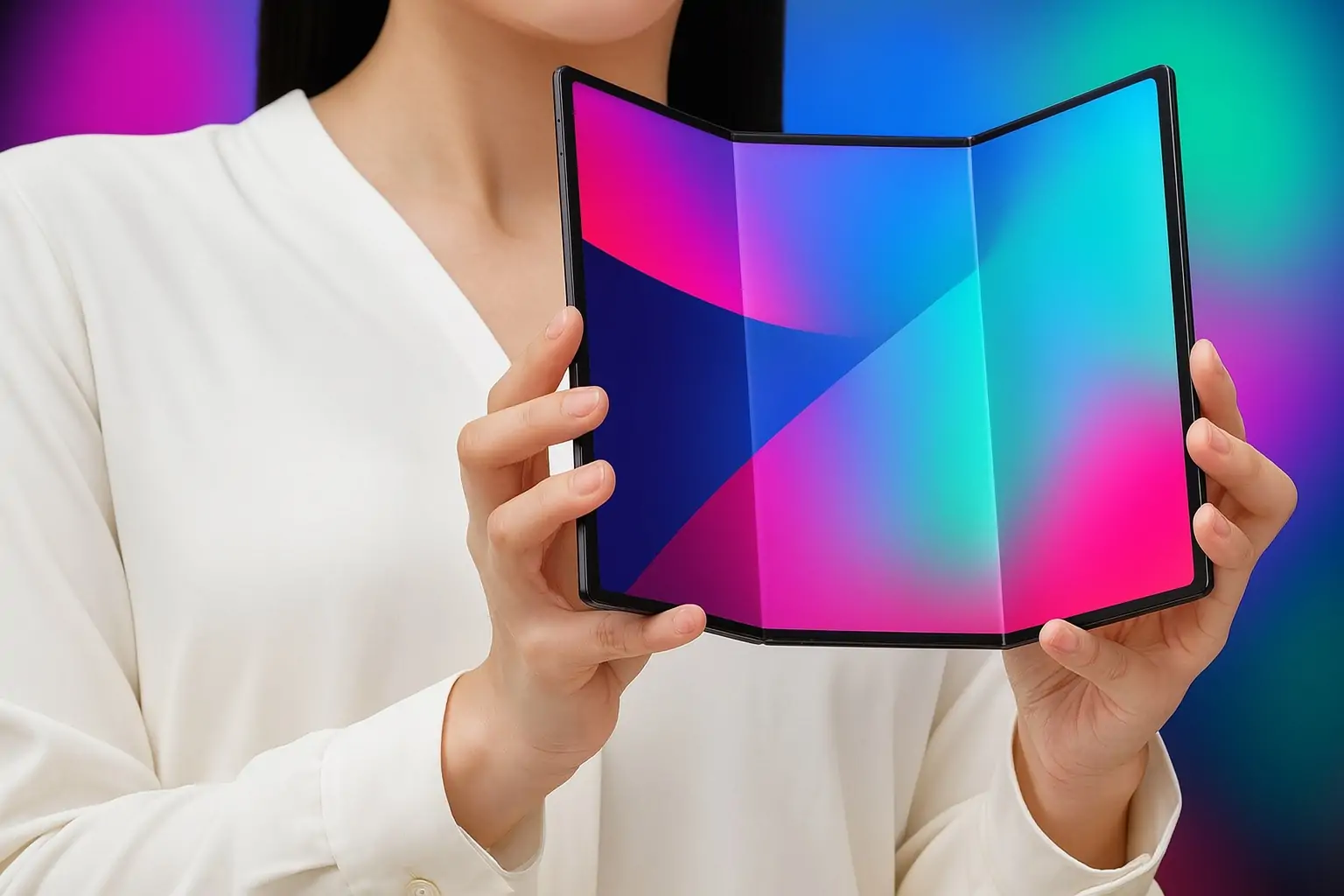
The world’s first mainstream tri‑fold phone is finally real – but should you actually buy the Samsung Galaxy Z TriFold, or stick with a more traditional foldable instead? Here’s everything you need to know today, December 4, 2025.
What’s new with the Galaxy Z TriFold today (December 4, 2025)?
Samsung’s radical Galaxy Z TriFold has gone from long‑running rumor to real product in just a few days, and December 4 brings a fresh wave of news, videos and hot takes around the device.
Here are the key developments today:
- Official unboxing video goes live – Samsung has published an “Unfolding What’s Next” unboxing video that shows the Galaxy Z TriFold’s box contents, its 10‑inch main screen, three‑app multitasking and on‑device Samsung DeX experience. Samsung positions the phone as a lightweight, versatile device that turns into a mobile workspace and cinematic screen on demand. 1
- Global launch likely tied to ‘The First Look’ event at CES 2026 – A new report from Gadgets360 confirms Samsung will host The First Look event in Las Vegas on January 4, 2026, two days before CES. The article says the event is expected to be the stage where Samsung globally showcases the Galaxy Z TriFold and finally reveals U.S. pricing, after its Korean debut this week. 2
- Price and early availability sharpen into focus – In South Korea, the Galaxy Z TriFold starts at KRW 3,594,000 (about $2,400 / roughly ₹2.2 lakh), according to Samsung’s launch coverage and follow‑up reporting. Reuters Analysts told Reuters they see the device more as a halo product and technology showcase than a mass‑market hit, at least for now. 3
- Specs and design fully detailed – Tom’s Guide’s “everything we know” explainer, updated December 4, lays out a 10‑inch Dynamic AMOLED 2X main screen, a 6.5‑inch outer display, Snapdragon 8 Elite for Galaxy, 16GB RAM, up to 1TB storage, a 5,500–5,600mAh battery, IP48 protection and a super‑thin 3.9mm profile when unfolded. 4
- First big opinion pieces land – A new Tom’s Guide column published today lists “5 big questions” that still need answering, including real‑world battery life, crease visibility and long‑term durability. Tom’s Guide Android Authority’s latest editorial goes even further, advising many buyers to skip the first‑gen TriFold and buy the more mature Galaxy Z Fold 7 instead, citing concerns over durability, battery demands and unknown pricing. 5
- Tri‑fold race intensifies: Xiaomi enters the chat – HuaweiCentral reports that Xiaomi appears to be preparing its own tri‑fold phone, after a mysterious foldable with a new model number showed up in the GSMA database. The site suggests it could be a MIX TriFold device targeting a 2026 launch, adding a third competitor to a category currently dominated by Huawei and now challenged by Samsung. 6
In other words: today is the moment the Galaxy Z TriFold stopped being a rumor and became a real, controversial product with both huge promise and serious caveats.
What is the Samsung Galaxy Z TriFold?
At its core, the Samsung Galaxy Z TriFold is a phone that unfolds twice to become a tablet‑class device.
From Samsung’s official specs and multiple launch reports, here’s the short version of the hardware: 4
- Main display:
- 10‑inch Dynamic AMOLED 2X
- 2160 × 1584 resolution
- Up to 120Hz refresh rate
- Cover display:
- 6.5‑inch Dynamic AMOLED 2X
- 2520 × 1080, 120Hz
- Chipset & memory:
- Snapdragon 8 Elite (for Galaxy)
- 16GB RAM
- 512GB or 1TB storage
- Cameras:
- Rear: 200MP main + 12MP ultra‑wide + 10MP 3x telephoto
- Front: 10MP selfie cameras on both the cover and main screens
- Battery & charging:
- ~5,600mAh three‑cell battery spread across the three panels
- 45W wired charging, 15W wireless charging
- Build & durability:
- Dual Armor FlexHinges with two different hinge sizes
- Advanced Armor Aluminum frame and hardened glass on outer panels
- IP48 rating for dust and water resistance
- 3.9mm at its thinnest point unfolded, but around 309g in weight
- Software:
- Android 16 with One UI 8
- Standalone Samsung DeX on the internal 10‑inch screen
- Multi‑window with up to three portrait apps side‑by‑side (or more in DeX)
- Galaxy AI features such as Generative Edit and Photo Assist
Samsung’s own product page frames the TriFold as a shape‑shifting device that can morph from a normal phone into a workspace and then into a movie screen, all with “ultra‑level performance” and dual hinges that fold inward to protect the main display. 7
3 reasons to buy the Samsung Galaxy Z TriFold
Based on Samsung’s announcements, early hands‑on videos and analysis from outlets like Tom’s Guide, here are the strongest arguments in favor of this ultra‑premium foldable. 8
1. A 10‑inch OLED canvas in your pocket
The obvious headline feature is the screen: when fully unfolded, the Galaxy Z TriFold gives you a 10‑inch Dynamic AMOLED 2X display, nearly a quarter larger than the Z Fold 7’s inner panel. 8
Both the inner and outer displays support up to 120Hz refresh rates, and the main screen is rated for high brightness levels that should handle outdoor use well. 4
That much screen real estate unlocks a few key use‑cases:
- Tablet‑like media experience – Movies, sports and games feel closer to a small tablet than a phone.
- True multi‑tasking – Samsung’s software allows three full‑height apps side‑by‑side on the inner panel, plus a taskbar and floating windows in DeX mode. 1
- Better productivity on the go – You can open email, a browser and a document at once without everything feeling cramped.
If you’ve ever wished your foldable felt just a bit more like a real tablet, this is exactly the problem the TriFold is trying to solve.
2. Samsung’s most advanced foldable hardware yet
Samsung has clearly designed the Z TriFold to address some of the durability concerns that still hang over foldable devices. 8
Key hardware upgrades include:
- Dual, differently sized hinges built on the Armor FlexHinge introduced with the Z Fold 7, which helps minimize the gaps between panels when closed and reduce dust ingress. 8
- In‑software protection – If you try to fold the phone the wrong way, the device triggers vibration and an on‑screen warning to prevent accidental strain on the hinges. 9
- Premium materials – An Advanced Armor Aluminum frame and hardened glass on the outer panels improve scratch resistance and rigidity. 4
- IP48 rating – While not as robust as IP68, it still offers meaningful dust and water protection (including submersion at shallow depth for a limited time), an important milestone for such a complex design. 4
On top of that, the three‑cell 5,600mAh battery is the largest Samsung has ever put in a flagship phone, and it supports 45W wired fast charging – a significant bump over the Z Fold 7’s 25W. 10
For early adopters, the message is clear: this is Samsung’s most sophisticated foldable engineering project so far.
3. Flagship specs, cameras and long‑term software support
The Galaxy Z TriFold isn’t just a weird new form factor – it’s also a full‑blown flagship. 8
Highlights include:
- Snapdragon 8 Elite for Galaxy – A top‑tier chipset optimized for Samsung’s devices.
- 16GB RAM and up to 1TB of storage, matching or beating most “normal” flagship phones.
- A 200MP main camera, 12MP ultra‑wide and 10MP 3x telephoto lens, plus dual 10MP selfie cameras – the same core hardware as the Galaxy Z Fold 7’s well‑reviewed camera stack. 8
- Galaxy AI tools like Photo Assist, Generative Edit and live translation, plus a standalone Samsung DeX mode that can run multiple apps at once directly on the internal display. 8
- Long‑term support – Samsung has committed to seven years of Android OS updates for recent flagships, and coverage of the TriFold indicates it will get the same treatment. 9
If you’re already deep in the Galaxy ecosystem and want the most future‑proof, spec‑heavy device Samsung makes, the TriFold fits that bill.
2 reasons you may want to skip the Galaxy Z TriFold (for now)
For all its ambition, the Galaxy Z TriFold comes with serious trade‑offs – and they’re exactly what you’d expect from a first‑generation ultra‑premium concept device.
1. The price and availability are brutal
Let’s start with the obvious: this phone is extremely expensive.
- In South Korea, Samsung set the price at KRW 3,594,000 (about $2,440 / ~₹2.2 lakh) for the 16GB + 512GB variant. 3
- Currency conversions suggest a European price in the €2,100 range and a U.S. price somewhere around $2,400–$2,800, though official U.S. pricing will only be announced around The First Look event in January. 2
Tom’s Guide notes that early speculation put the price as high as $3,000, and even with the lower Korean figure, we’re still looking at a device that will cost substantially more than the $1,999 Galaxy Z Fold 7. 8
And that’s before you consider availability:
- The TriFold launches first in South Korea on December 12, 2025. 3
- Samsung has confirmed it will come to China, Taiwan, Singapore, the UAE and the U.S., but only in limited channels and quantities. 11
- Gadgets360 reports that the global showcase and U.S. price reveal are expected at the January 4 “First Look” event, with a broader rollout following later in Q1 2026. 2
Analysts quoted by Reuters suggest this will be a niche, halo product used to test demand and tech rather than a volume driver any time soon. 3
If you’re cost‑sensitive or live outside Samsung’s initial launch markets, the TriFold will be a very tough sell.
2. Weight, bulk and durability question marks
The TriFold may be ultra‑thin when open, but when it’s folded up and in your pocket, the story changes.
Tom’s Guide and other first‑look reports highlight several concerns: 8
- Weight: At about 309g, the Galaxy Z TriFold is roughly 50% heavier than the Galaxy Z Fold 7 and noticeably heavier than mainstream flagships like the Galaxy S25 Ultra or iPhone 17 Pro Max. You will feel it. 10
- Bulk when folded: Each of the three sections is just 3.9mm thick on its own, but stack them and you end up with a chunky brick in your pocket. 4
- Two visible creases: Early hands‑on videos and written impressions confirm that, while the creases are comparable in depth to the Z Fold 7’s, there are now two of them running across the inner display. 9
- Fussy exterior finish: The fibreglass composite on the back has been described as smudge‑prone and slightly sticky, which may not be to everyone’s taste. 8
- No S Pen support: Despite the big canvas, Samsung has not enabled stylus support, a disappointment for note‑takers and digital artists who hoped the TriFold would replace both phone and tablet. 8
Durability is the big unknown. The IP48 rating and reworked hinge system are encouraging, but adding extra moving parts inherently increases the number of possible failure points. Android Authority’s analysis underlines concerns about long‑term hinge wear, internal display robustness and the cost of repairs, especially since Samsung is reportedly offering a one‑time 50% repair discount for the TriFold – a hint that fixes won’t be cheap. 5
Battery life is another open question. Yes, 5,600mAh is a large capacity, but it’s also powering a larger panel than any previous Galaxy phone. Tom’s Guide points out that even the smaller‑screened Z Fold 7 delivered only middling endurance in lab tests, so we’ll need real‑world figures before declaring the TriFold an all‑day workhorse. 4
Galaxy Z TriFold vs Huawei Mate XTs – and Xiaomi’s upcoming rival
Samsung is not the first to ship a tri‑fold device. Huawei’s Mate XTs beat it to market earlier this year, but the two products take very different approaches. 4
According to a fresh comparison from The Times of India, here’s how they stack up: 10
- Folding style
- Galaxy Z TriFold: Inward‑folding design with two hinges and a separate 6.5‑inch outer display; the main 10‑inch screen stays protected inside.
- Huawei Mate XTs: Outward‑folding design where the 10.2‑inch OLED screen wraps around the outside of the device, maximizing visible area but exposing the panel to scratches.
- Displays & performance
- Samsung: 10‑inch QXGA+ AMOLED inner display at 120Hz, Snapdragon 8 Elite for Galaxy.
- Huawei: 10.2‑inch OLED screen at 2232 × 3184, powered by Huawei’s Kirin 9020.
- Cameras
- Samsung: 200MP + 12MP + 10MP rear, dual 10MP front cameras.
- Huawei: 50MP + 40MP + 12MP rear, 8MP front.
- Battery & charging
- Both pack 5,600mAh batteries.
- Samsung supports 45W wired and 15W wireless charging, while Huawei goes harder at 66W wired and 50W wireless.
- Software
- Samsung runs Android 16 with One UI, with full Google services and an emphasis on DeX and multi‑window productivity.
- Huawei uses HarmonyOS 5.1, still missing native Google apps in many regions.
From a Western buyer’s perspective, Samsung’s TriFold will likely be far easier to live with thanks to Google Play access and wider international availability, even if Huawei has beaten it on charging speeds and screen real estate. 4
Looking ahead, HuaweiCentral’s report that Xiaomi is preparing a tri‑fold based on a recent GSMA database listing suggests the race is just beginning. If that device lands in 2026 as expected, early adopters who hold off on this first generation may find a much more competitive market waiting for them. 6
Who is the Galaxy Z TriFold really for?
Put all of this together and a clear picture emerges of the ideal Galaxy Z TriFold buyer:
- Power users and road warriors who want a genuinely usable 10‑inch workspace in their pocket and live inside apps like Outlook, Slack, Teams, Google Workspace and creative tools.
- Content creators and reviewers who want to experience (and show off) the bleeding edge of mobile design.
- Developers and UX designers exploring how apps can adapt to tri‑fold layouts and multi‑window configurations.
- Collectors and enthusiasts who routinely buy ultra‑high‑end tech and keep it as part of a long‑term device rotation.
For most people, though, the verdict from early commentary is cautious: you’re probably better off with a more affordable and battle‑tested foldable like the Galaxy Z Fold 7 in 2025, then revisiting the tri‑fold concept in a generation or two once prices fall and durability is proven. 5
Key Samsung Galaxy Z TriFold FAQ (as of December 4, 2025)
When is the Galaxy Z TriFold release date?
- South Korea: December 12, 2025
- Other markets (China, Taiwan, Singapore, UAE, U.S.): starting late 2025 into early 2026, with a major global showcase at The First Look event on January 4, 2026 in Las Vegas. 3
How much does the Galaxy Z TriFold cost?
- Korea: KRW 3,594,000 (~$2,400 / ~₹2.2 lakh) for 16GB + 512GB.
- Expected (not final): roughly €2,100 in Europe and somewhere in the $2,400–$2,800 range in the U.S., based on currency conversions and analyst estimates. Official U.S. pricing is due in January. 3
Is the Galaxy Z TriFold the first tri‑fold phone?
Not globally. Huawei’s Mate XTs was the first widely publicized tri‑fold, but it launched without Google apps and has limited availability outside China. Samsung’s TriFold is the first tri‑fold from a major Android vendor that’s explicitly targeting a broader global market. 4
Should you wait for Xiaomi’s tri‑fold instead?
Xiaomi is reportedly working on a tri‑fold device that could launch in 2026, but details are scarce. If you’re just tri‑fold‑curious rather than desperate to be first, it might be wise to see what Samsung, Huawei and Xiaomi all offer a year from now before dropping several thousand dollars. 6
Bottom line
On December 4, 2025, the Samsung Galaxy Z TriFold is simultaneously:
- The most futuristic phone Samsung has ever shipped,
- One of the most expensive mainstream phones you’ll be able to buy, and
- A first‑generation experiment whose long‑term durability and value remain unproven.
If you’re the kind of user who loves being first, understands the risks and can afford the price tag, the TriFold offers a genuinely new way to think about a phone, a tablet and a laptop all in one device.
If you’re not? The growing chorus of cautious voices – including reviewers urging buyers to stick with the Galaxy Z Fold 7 for now – is worth listening to. 8
Either way, Samsung has just turned the tri‑fold phone from sci‑fi into reality, and the rest of the industry is already racing to catch up.