
WASHINGTON, January 18, 2026, 06:28 EST
- NASA’s TESS spacecraft has paused its scheduled Sector 99 activities to focus on a unique observation of interstellar comet 3I/ATLAS.
- The mission team plans to downlink data on Jan. 19 and Jan. 26, with files going straight to public archives—no proprietary holdbacks.
- 3I/ATLAS, initially spotted in July 2025 by the ATLAS survey in Chile, ranks as the third interstellar object confirmed to travel through our solar system.
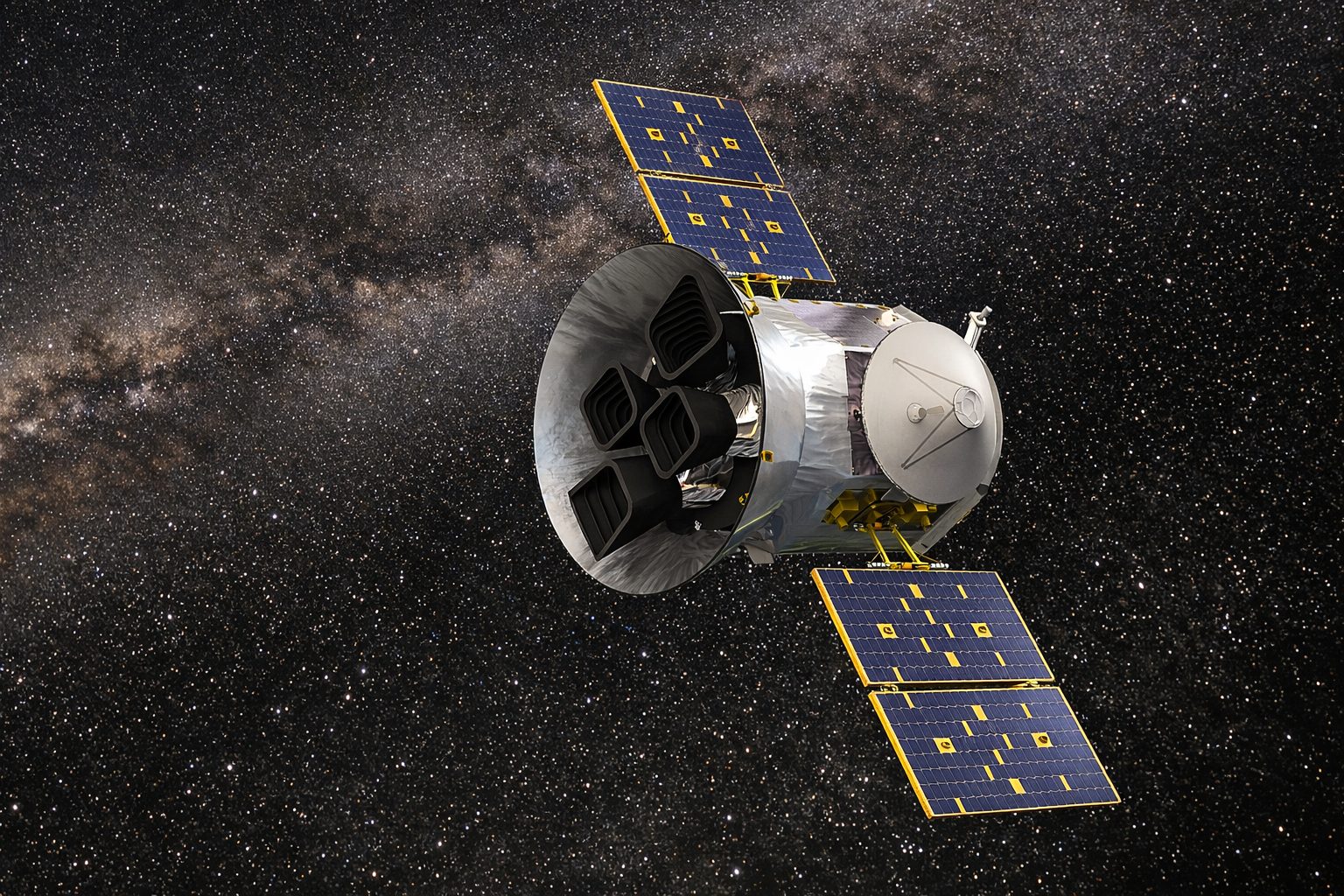
NASA’s Transiting Exoplanet Survey Satellite, better known as TESS, has paused its regular mission to focus on interstellar comet 3I/ATLAS. The spacecraft is now tracking this visitor from beyond our solar system as it makes its exit.
The timing is crucial since this object is already moving away. Having passed its closest point to the Sun, it’s dimming as it retreats, reducing the window for extended, consistent observation.
TESS is designed to track minuscule brightness fluctuations — photometry — across extended, uninterrupted periods. When observing a comet, this light curve can reveal rotation, sudden activity spikes, and changes in the surrounding dust-and-gas envelope.
The special pointing, called Sector 1751, began around 0600 UTC on Jan. 15 and is set to wrap up around 1200 UTC on Jan. 22, according to an update from the TESS Science Support Center dated Jan. 16. The team anticipates a roughly five-hour downlink on Jan. 19 — a planned transmission of stored observations back to Earth.
The update noted that TESS will gather full-frame images covering the spacecraft’s entire field of view, plus rapid “target pixel files” captured every 20 and 120 seconds. These postage-stamp boxes measure 50-by-50 pixels and are placed along the comet’s path, with extra data collected for bright calibration stars.
Mission staff anticipate downlinks on Jan. 19 and Jan. 26, with data set to be posted on the Mikulski Archive for Space Telescopes (MAST) immediately and without any proprietary period. They warned that the usual mission light curves along the comet’s trajectory “are not expected to be useful” and won’t be archived. However, other specialized products will be released at a later date.
TESS isn’t new to 3I/ATLAS. Mission staff noted in a Jan. 14 bulletin that research teams had already spotted the object in full-frame images dating back to May and June 2025—well before its official discovery. They used custom extraction techniques to track the moving target across the detector and detect brightness changes.
ATLAS, which stands for the Asteroid Terrestrial-impact Last Alert System, first notified the Minor Planet Center about the comet on July 1, 2025, from Rio Hurtado, Chile, according to NASA. The comet follows a hyperbolic path, indicating it isn’t gravitationally bound to the Sun. It will pass no closer than roughly 170 million miles—about 1.8 astronomical units, the average distance between Earth and the Sun.
Public interest has tracked the science closely. On Jan. 16, the Italy-based Virtual Telescope Project offered a live stream of 3I/ATLAS through a robotic 14-inch telescope, conditions allowing. Founder Gianluca Masi described it as “a very precious opportunity” to catch the comet in real time. Space
Major observatories have been keeping an eye on the comet, including NASA’s Hubble and James Webb space telescopes. It’s sparked plenty of online buzz, but in a November briefing, NASA’s science chief Nicola Fox confirmed there were no signs of “technosignatures.” Amit Kshatriya from NASA was straightforward: “This object is a comet.” Reuters
The TESS run won’t be a straightforward lab test. The mission anticipates 3I/ATLAS to hover near 16th magnitude, which is quite faint. It will streak across the camera’s view, meaning analysts have to distinguish it from background stars and spacecraft glitches—all while juggling a downlink schedule that might shift.
After the special pointing wraps up, TESS will get back to its usual survey routine. The comet will continue its one-way journey out of the solar system as researchers anticipate the first downlinked files and, eventually, the tailored data products the mission team intends to compile.