
LONDON, Jan 22, 2026, 13:15 (GMT)
- The Met Office reported that northern UK latitudes could still see auroras tonight, but cloud cover might block the view.
- NOAA predicted geomagnetic activity would hit minor-storm levels on Jan. 22 as the earlier solar storm winds down.
- Tonight and Friday evening, a waxing crescent Moon moves past Saturn, while Jupiter remains prominent in the eastern sky.
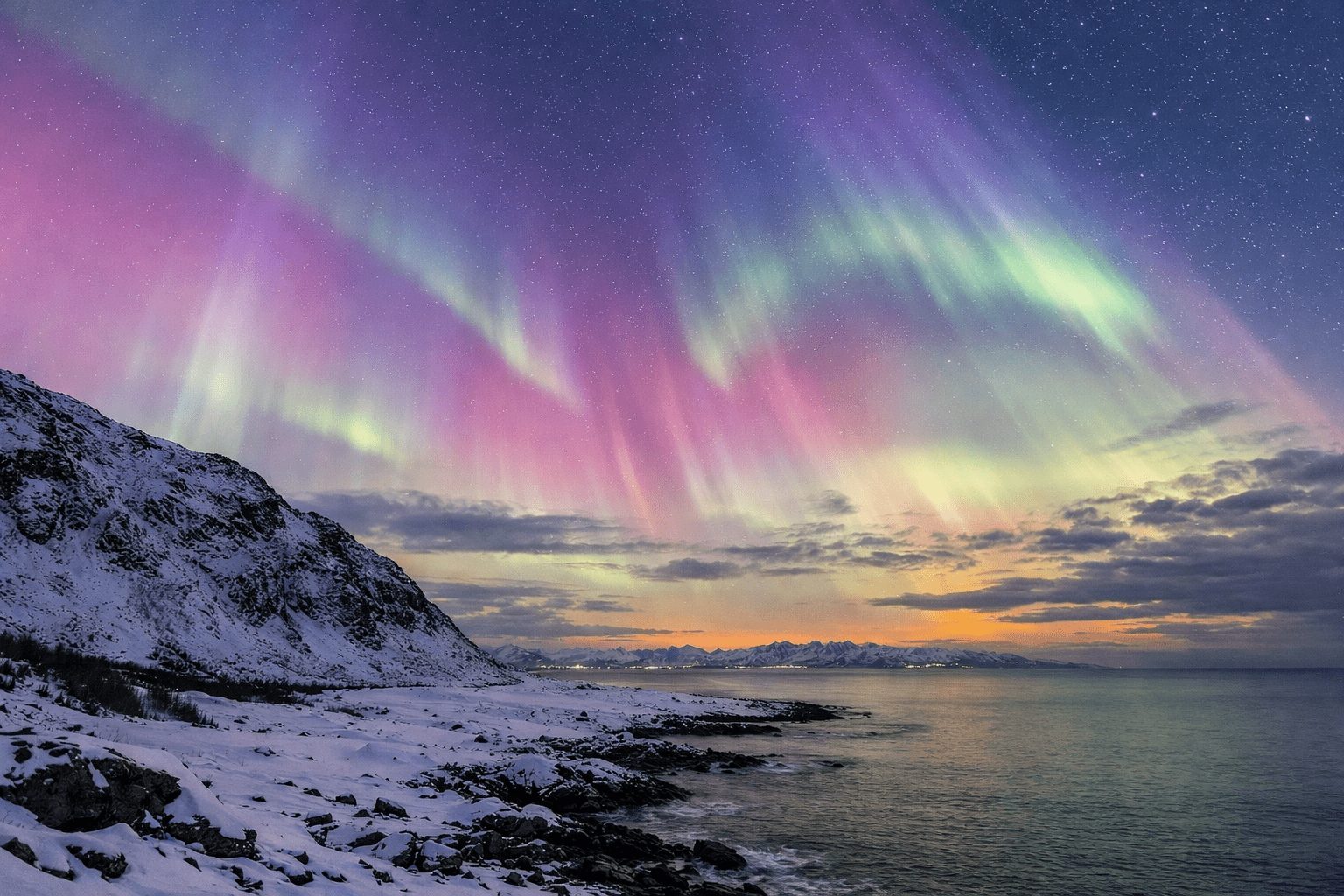
The Met Office says parts of northern Scotland might still catch a glimpse of the Northern Lights tonight as geomagnetic activity winds down following this week’s solar storm. However, widespread cloud cover is likely to block much of the view.
This is important since the recent spike in space weather sent auroras far beyond their typical high-latitude zones, leaving many enthusiasts hoping for another display. It also keeps airlines and satellite operators on alert, as space weather can interfere with radio communications and degrade navigation signals.
Auroras appear when charged particles from the Sun slam into gases far up in Earth’s atmosphere, creating a faint light that can flare up brightly during intense geomagnetic storms. Forecasters rely on the Kp index—a scale from 0 to 9—to gauge how much Earth’s magnetic field is being disturbed.
The U.S. National Oceanic and Atmospheric Administration’s Space Weather Prediction Center released a three-day forecast Thursday, predicting a peak three-hour Kp index of 4.67 on Jan. 22. This level is classified as a G1, or minor storm. The forecast linked the disturbance to ongoing effects from the Jan. 19 coronal mass ejection — a CME, which is a burst of solar plasma and magnetic field — interacting with fast solar wind streaming from a coronal hole.
A G1 ranks lowest on NOAA’s five-step geomagnetic scale, yet it can still push auroras into lower latitudes when conditions align. Usually, the more vivid colors and brighter arcs remain nearer the poles.
Australia’s Bureau of Meteorology, which operates the Australian Space Weather Forecasting Centre, predicted mostly quiet geomagnetic conditions on Thursday, though a chance of G1 storming remains as solar wind continues to be “strong to very strong” throughout the UT day. Additionally, high-frequency radio conditions are expected to be below normal, with “maximum usable frequencies” — the highest frequency capable of supporting a radio link — down by 10% to 15% compared to monthly averages. Space Weather
The earlier event was more intense. NOAA reported that severe G4 storm conditions hit at 2:38 p.m. EST (1938 UTC) on Jan. 19, triggered by the CME shock arrival. They also cautioned that severe levels might persist while the CME moved through.
Prior to that, NOAA put out a G4 watch for Jan. 20 UTC, warning that storm levels might sit anywhere between G1 and G3 when the CME hits late on Jan. 19 in the U.S. They noted there’s “a fair measure of confidence” in the timing of the CME’s arrival. NOAA Space Weather Prediction Center
Krista Hammond, Space Weather Manager at the Met Office, reported that the UK experienced a G4 geomagnetic storm overnight Monday into Tuesday. This event made the aurora visible across much of the country, with sightings reported as far south as northern Italy. “At this stage in the solar cycle, we’d expect geomagnetic storms of this strength a couple of times a year,” she noted. Met Office
If you missed the aurora, the night sky still has easy sights. EarthSky reports a waxing crescent Moon will slide past Saturn on the evenings of Jan. 22 and 23, low in the west, with both setting before midnight. Bright Jupiter will rise higher in the east as darkness falls and stay visible deep into the night throughout this month.
BBC Sky at Night Magazine reported that the storm’s peak intensity has probably eased, but the aurora could still appear over the next few nights, especially with the moon in a darker phase. For the UK, prime viewing is from sunset until dawn. In North America, the best window is typically between 22:00 and 02:00 local time.
Aurora forecasts can change quickly. The brightness hinges not only on the volume of incoming solar wind but also on the magnetic field’s direction. Plus, local clouds or city lights can easily turn a hopeful alert into nothing but empty sky.
At the moment, forecasters expect the disturbance to calm down more, making Jupiter and a dim Saturn the more reliable sights for those venturing out after dark.