
BUSAN, August 22, 2026, 03:21 KST
- Samsung says the curved area of a conventional foldable can fall to about 40% of front-facing brightness.
- The 7.6-inch prototype changes the OLED emitting layer, not the phone hinge.
- No customer, device, price or production date has been announced.
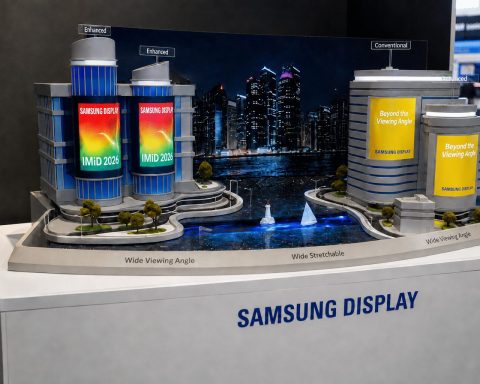
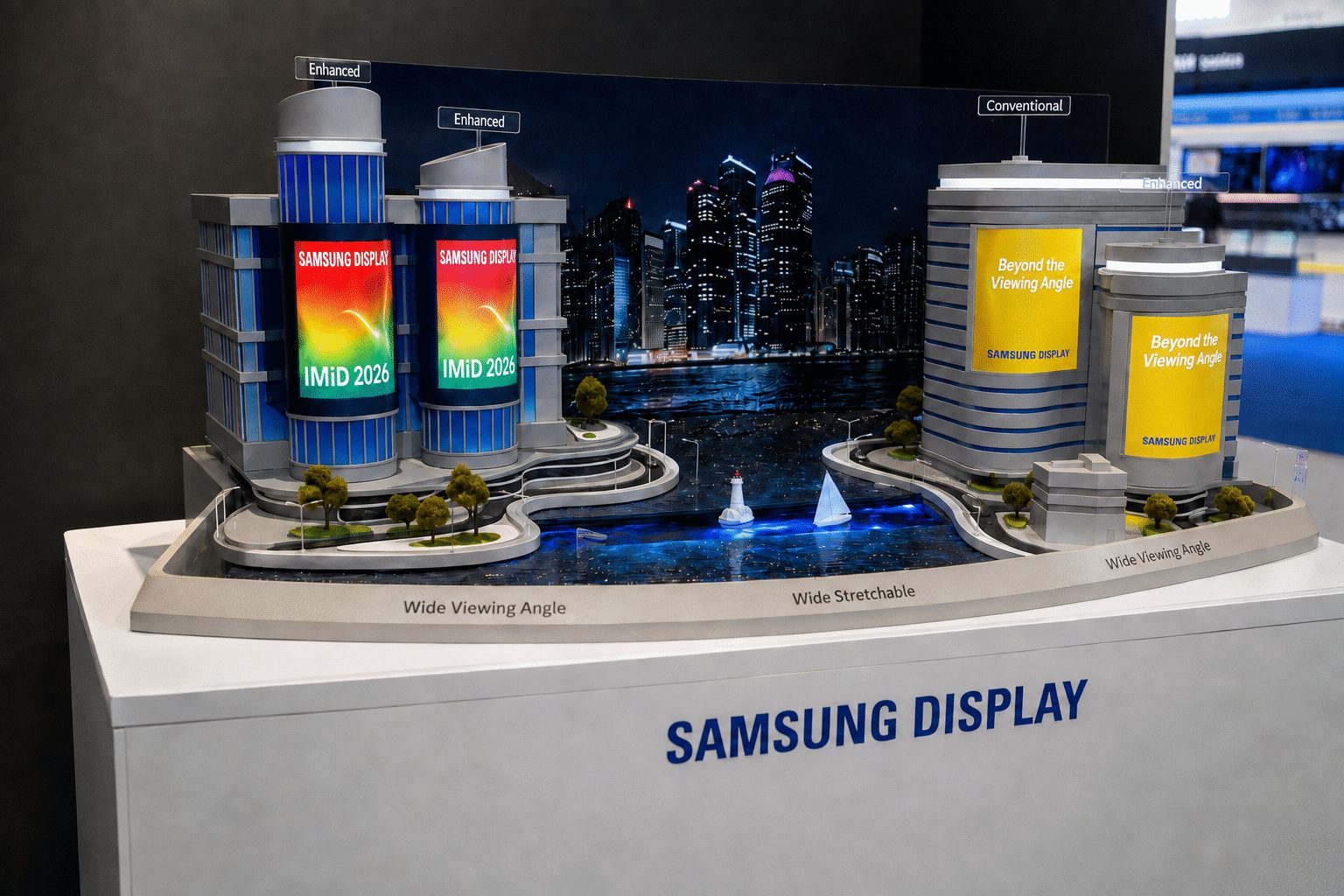
Samsung Display, a unit of Samsung Electronics (KRX:005930), has shown a 7.6-inch OLED designed to keep foldable screens bright near the bend. The Wide View Display made its debut at IMID 2026 in Busan, which ended Friday.
The demonstration targets a less visible weakness than the physical crease. Samsung says the curved region beside a conventional fold can appear at roughly 40% of the flat section’s brightness when viewed head-on. That drop can make one large screen look like separate panels.
Samsung redesigned the organic emitting layer’s materials and structure. It says the change produces more even luminance across flat and curved areas. The company has not published nit measurements or independent test results.
| Foldable-screen issue | Conventional OLED | Samsung Wide View OLED | What is verified |
|---|---|---|---|
| Brightness near bend | About 40% of front-facing flat area, according to Samsung | Described as bright and uniform | No absolute nit figure disclosed |
| Technical change | Existing emitting-layer design | Reworked emitting-layer materials and structure | Panel change, not a hinge change |
| Screen size shown | Not specified for comparison unit | 7.6 inches | Mobile OLED prototype |
| Commercial status | Already used across foldable products | Exhibition prototype | No device or production date named |
The distinction matters for buyers. Wide View addresses brightness and viewing-angle uniformity, not the physical valley in a folding screen. Samsung made no claim that the technology removes a crease.
The same optical approach could support slidable and rollable panels. Those products also curve parts of the screen away from the viewer. Samsung did not identify a handset maker or a launch window.
Across the aisle, LG Display (KRX:034220) introduced FLiPP, an OLED pixel-patterning process that removes the fine metal mask. Under identical conditions, LG says FLiPP can deliver 1.6 times the brightness or 2.4 times the life while cutting power use by 13%. Its aperture ratio rises about 55%.
“We were able to successfully realize FLiPP,” LG Display CTO Choi Young-seok said. LG plans to start with tablets and monitors, but gave no commercial date.
| IMID technology | Primary problem | Verified metric | First target | Availability |
|---|---|---|---|---|
| Samsung Wide View OLED | Brightness loss around curved screen areas | 7.6-inch demo; conventional bend cited near 40% brightness | Foldable, slidable and rollable devices | Not disclosed |
| LG FLiPP | Fine-metal-mask limits in OLED production | 1.6× brightness or 2.4× life; 13% lower power; 55% higher aperture ratio | Tablets and monitors | Not disclosed |
| Samsung Wide Stretchable | Limited stretchable display area | 20 inches; more than twice the prior screen area | Cars, humanoids and signage | Not disclosed |
The two launches attack different bottlenecks. Wide View changes what users see around a fold. FLiPP changes how factories form RGB pixels, with possible gains in yield and substrate use.
Samsung also used IMID to broaden its display pipeline. Its 20-inch Wide Stretchable joins two panels and more than doubles the earlier display area. The company showed automotive and gaming panels as well.
| Samsung IMID display | Size | Verified capability | Intended use |
|---|---|---|---|
| Wide View OLED | 7.6 inches | More uniform brightness at curved viewing angles | Mobile foldables and other flexible devices |
| Wide Stretchable | 20 inches | Two tiled panels; more than twice prior area | Vehicle cockpits, humanoids, signage |
| Vertical slidable CID | Up to 15.5 inches | Vertically expanding center display | Vehicles |
| QD-OLED monitor panel | 31.5 inches | 4K resolution at 360Hz | Gaming and IT monitors |
The exhibition gave Samsung a research showcase as well. It presented 57 papers, the most among participating companies for a second year. More than 2,500 display specialists attended the Busan conference.
Risks: Wide View remains a trade-show prototype. Its performance figures are company statements, and Samsung has not disclosed durability, yield, cost, power use or mass-production readiness.
That leaves the key commercial question unanswered. The panel could make folds less visually uneven, but buyers cannot yet choose a device that uses it.
Related articles: Tech News